
Japan Is Scrapping the Cool Japan Fund. What That Means for Manga Readers Abroad
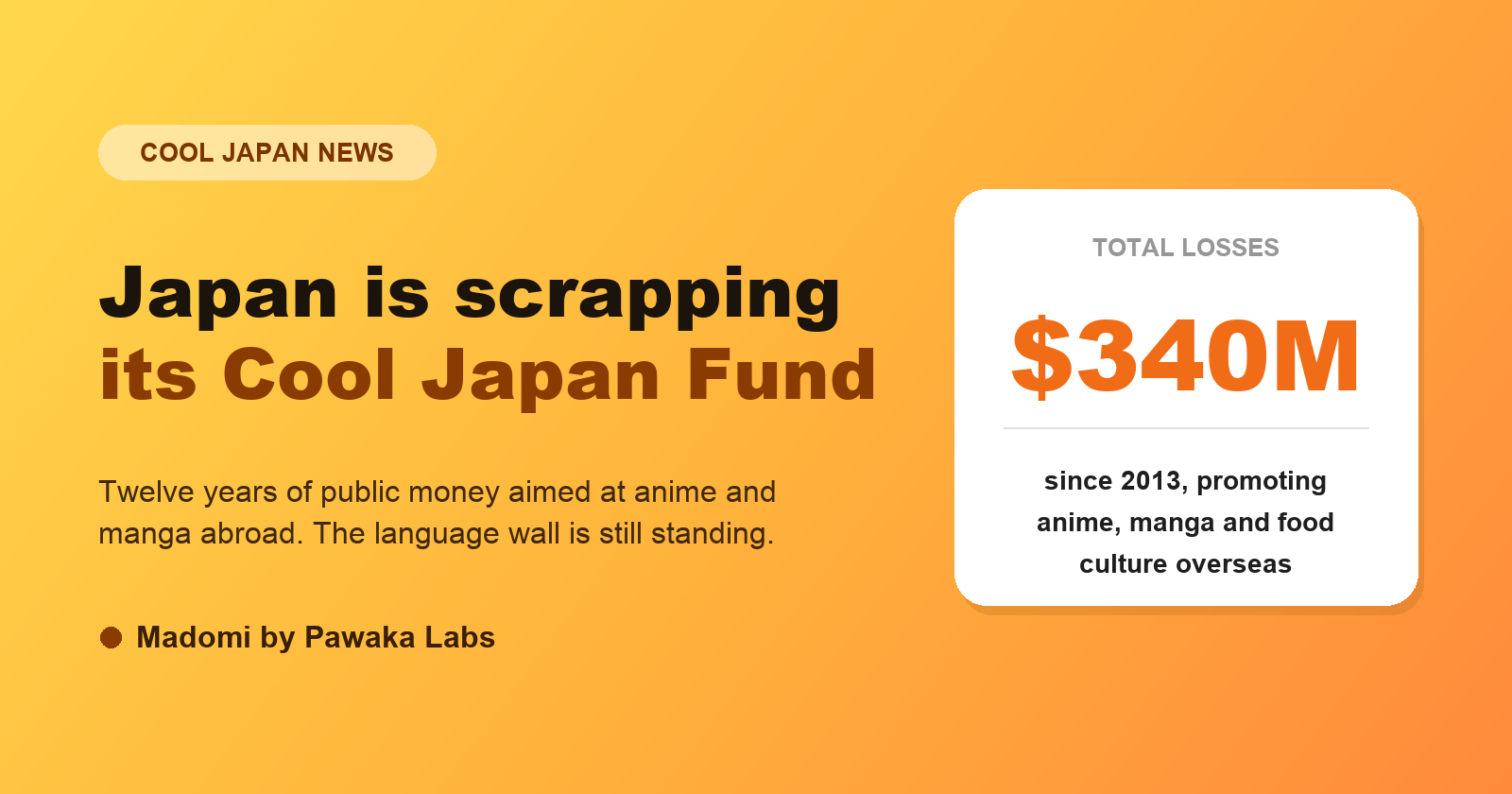
Japan spent twelve years and 54 billion yen trying to push its pop culture onto the rest of the world. This week its own trade ministry quietly gave up on the vehicle it used to do it.
The Ministry of Economy, Trade and Industry filed its budget request for the 2027 fiscal year with nothing set aside for the Cool Japan Fund, which is the polite bureaucratic way of ending something. No budget means no new investments. Japanese newspapers reported it on 20 August, and the government is expected to settle the fund’s fate formally by the end of the year.
Major Global News has the full breakdown with the figures and the sourcing: Japan Moves to Abolish Cool Japan Fund After $340 Million in Losses.
What the Cool Japan Fund Actually Was
It launched in November 2013 as a public-private investment vehicle, and it became one of the signature projects of Shinzo Abe’s second government. The idea was straightforward enough: Japan makes culture the world wants, so put state money behind the companies exporting it. Anime, manga, film, fashion, food.
By April 2026 it had invested 151.3 billion yen, with the Japanese government supplying 140.6 billion of that, across 83 projects. Cumulative losses: 54 billion yen, roughly $340 million. Revenue for fiscal 2025 fell 88 percent year on year to 4.4 billion yen, against a net loss of 15.7 billion.
A revised plan back in November 2022 was supposed to stop the bleeding by fiscal 2024 and hold losses at 42.6 billion yen. Instead the gap kept widening, which is how you end up with a trade minister saying out loud that abolition or a merger is on the table.
The Anime Investments You Might Remember
Some of this money went into names manga and anime fans will recognize, and the results are instructive.
It put $30 million into Sentai Holdings in 2019, the parent of Sentai Filmworks and HIDIVE, and another $3.6 million in 2020. In 2014 it backed Anime Consortium Japan, the joint venture behind the Daisuki streaming service, which shut down in 2017. In 2015 it lined up as much as 450 million yen for Kadokawa projects, including a training academy meant to produce 2,000 anime and manga creators overseas by 2020.
Notice what’s missing from that list. Not one of those bets was about getting a chapter into a reader’s language faster. They were about platforms, equity stakes and institutions, which is what a fund invests in, because a fund is a fund.
The Timing Is the Interesting Part
Two weeks ago we wrote about METI reportedly weighing $71 million in subsidies to get manga and anime companies translating with AI. That’s the same ministry, in the same budget year, still chasing its target of tripling overseas content sales to 20 trillion yen by 2033.
So Japan hasn’t lost interest in exporting its culture. What’s changing is the instrument. The venture-fund model, where the state takes equity and hopes for a return, is being retired. Direct subsidies aimed at a specific bottleneck, translation speed, are what’s being funded instead.
That’s a much better read of the problem, honestly. A reader in Jakarta or São Paulo doesn’t end up on a pirate site because Japanese culture needs more promotion overseas. They end up there because the chapter exists, they know it exists, and there’s no legal way to read it in a language they speak.
What Twelve Years of This Bought You as a Reader
Be honest about it: not much, if you read outside English.
MANGA Plus is genuinely good and genuinely free, and its language coverage has grown. VIZ’s Shonen Jump app is $2.99 a month. K MANGA covers Kodansha titles. Those are all worth using, and if your series is on one of them you should read it there, because the people who made it get paid.
But the catalogue those platforms cover is the commercially obvious slice. A 51-volume sports manga from 2003 that never got licensed anywhere is not on them. Neither are most Korean manhwa or Chinese manhua outside their home platforms. Neither is most of anything, in most languages that aren’t English.
A 204 billion yen fund did not change that, and the fund closing does not change it either. The wall was never a promotion problem.
Reading the Raw Manga While Policy Catches Up
This is the gap Madomi exists for.
Madomi is a real-time manga translator by Pawaka Labs that works as a browser extension on Chrome and Firefox and as a native app on Android and iOS. Open any raw manga chapter, activate Madomi, and it reads the Japanese text inside every speech bubble using OCR built for manga fonts, then overlays the translation in your language as you scroll.
It’s rated 4.8 out of 5 from 383 Chrome Web Store ratings with 20,000+ users, which makes it the highest-rated manga translator extension on the Chrome Web Store. There are free credits every month (1 credit per translated image), and Madomi Premium if you want unlimited.
The way we suggest using it hasn’t changed. Buy the volumes or chapters from a legitimate Japanese ebook store, then read them with Madomi on top. The author gets paid and you get the story, without waiting on a licensing decision that may never arrive. It handles Korean and Chinese titles too, which matters more than usual here, because official coverage there is thinner still. If that’s your corner, our guide to where to read Chinese manhua online is the place to start.
Quick Start Guide
- Install Madomi on Chrome, Firefox, Android or iOS.
- Check the official platforms first. MANGA Plus, Shonen Jump and K MANGA are free or cheap, and if your series is there, read it there.
- If it isn’t licensed in your language, buy the Japanese volumes from a legitimate store.
- Open a chapter, switch Madomi on, and let it overlay the translation as you scroll.
- Set your language in the settings. English is one option out of many, which is the entire point.
FAQ
Is the Cool Japan Fund officially abolished? Not formally yet. METI submitted its 2027 fiscal year budget request without funding for it, which stops any new investments, and the government is expected to reach a final decision by the end of 2026.
How much money did it lose? 54 billion yen, about $340 million, in cumulative losses since it launched in November 2013. Fiscal 2025 alone brought a net loss of 15.7 billion yen on revenue that fell 88 percent to 4.4 billion.
Does this mean Japan is cutting support for anime and manga? No. The same ministry is reportedly weighing 11.5 billion yen in subsidies for translation and overseas expansion, and it still has a target of tripling content exports to 20 trillion yen by 2033. What’s ending is the fund model, not the policy.
Will official translations get slower now? Unlikely to be connected. The fund invested in companies and platforms, not in translation pipelines, so its closure doesn’t remove anything that was speeding chapters up.
Why is so much manga still unavailable in my language? Licensing is decided title by title and market by market, and most titles never clear that bar outside English. That’s a commercial calculation, not a policy gap, and no amount of state promotion changes the arithmetic on a 20-year-old series.
Is reading raw manga with Madomi legal? Buying the Japanese volumes and translating them for your own reading is fine. Pirate sites are what we’d steer you away from, and they’re the behavior every one of these policies is trying to reduce.
The Fund Is Closing. The Wall Isn’t.
Twelve years, 204 billion yen across 83 projects, and the series you want is still sitting there in Japanese.
You don’t need a ministry to fix that for you.
Read more anime and tech blogs
Keep reading
Japan's Government Is Backing AI Manga Translation. So Why Are You Still Waiting?
Japan's trade ministry is weighing $71 million to get manga and anime companies translating with AI. The reason is the same one readers already know about.

Overgeared Anime Premieres October 2. Here Is How to Read the Webtoon Ahead of It, Before Tapas Closes
The Overgeared anime premieres October 2, 2026. Where the 12 episodes leave off, where to read the webtoon ahead in English, and what to do when Tapas closes.

The IP Address in the Sword Art Online Finale Was a Real Server: What 52.68.96.58 Showed
The IP address shown in the final episode of Sword Art Online: War of Underworld, 52.68.96.58, led to a real server with a farewell page. What it showed, and what's there now.

The Apothecary Diaries Season 3 Premieres October 2. Here Is How to Read Ahead of It Today
The Apothecary Diaries Season 3 premieres October 2, 2026. Here's exactly where the anime leaves off, and how to read the light novel and manga ahead of it.

Bilibili Is Going Global. Here's What It Means for Manhua and Donghua Fans
Bilibili relaunched its international app with no Chinese ID required. What that means for donghua streaming and reading manhua raws outside China.