
Japan's Government Is Backing AI Manga Translation. So Why Are You Still Waiting?
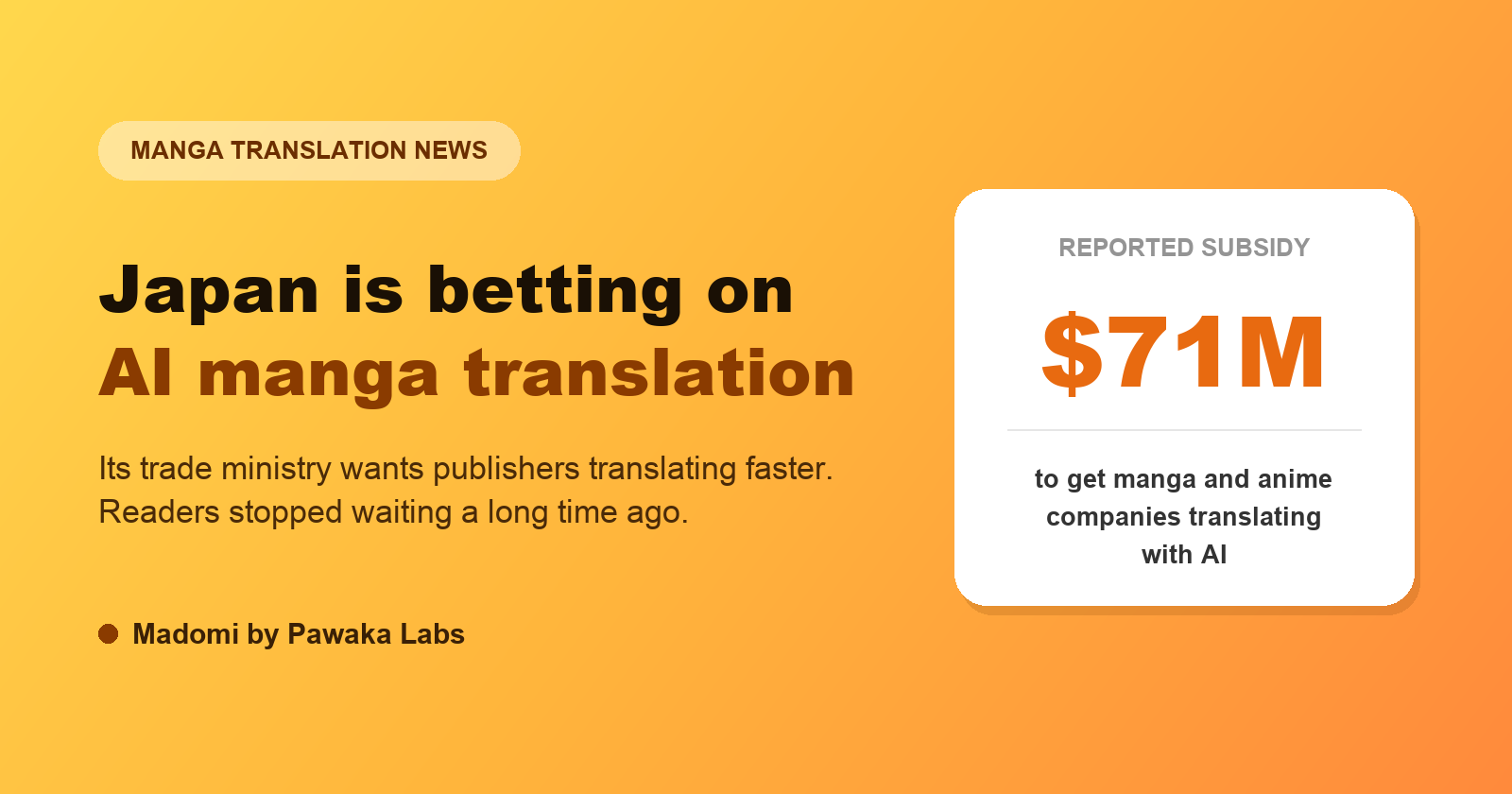
For years the standard objection to AI manga translation was that it’s a shortcut real readers shouldn’t take. Japan’s own trade ministry is now reportedly preparing to pay publishers to do exactly that.
The Yomiuri Shimbun’s English desk reported that Japan’s Ministry of Economy, Trade and Industry is considering 11.5 billion yen, roughly $71 million, in subsidies for 15 entertainment companies, with the money aimed squarely at getting them translating with artificial intelligence. The expected recipients are not small: Shueisha, Kodansha, Square Enix and NTT Solmare on the manga side, Crunchyroll and Bandai Namco on the anime side, plus companies from music, gaming and live-action.
Major Global News covered the reporting in detail if you want the figures and the sourcing: Japan weighs $71 million in AI translation subsidies for manga and anime firms.
We should be upfront about one thing. METI hasn’t formally announced this. It’s newspaper reporting based on sources, and the final list of companies could change. But the direction is not really in doubt, because the reasoning behind it is public and it’s the same reasoning we’ve been writing about here for two years.
Why Japan Suddenly Cares So Much About Translation Speed
The number that explains everything is the piracy figure. Losses from pirated anime, manga and related works hit 5.7 trillion yen in 2025, up from 2 trillion yen in 2022. Counting infringement involving related merchandise, the total reaches 10.4 trillion yen.
Nearly tripling in three years is not the kind of trend a government ignores, especially now. Japanese content earned 6.13 trillion yen globally in 2024, which is more than the country made exporting semiconductors that year. Manga and anime are a serious export industry, and the ministry has a target of tripling overseas sales to 20 trillion yen by 2033.
The part that matters to you is the ministry’s diagnosis. It doesn’t blame readers. It says pirate sites post unauthorized translations faster than official ones arrive, so readers who want to keep up go where the chapters are. The proposed fix is to make the licensed version fast enough to compete. That’s a remarkably honest read of the situation, and it’s one that puts the blame on the pipeline rather than the audience.
The Case Against AI Manga Translation Just Got a Lot Weaker
If you’ve spent time in manga communities you’ve seen the argument. AI translation is lazy, it’s disrespectful to translators, real fans wait for the official release.
The waiting part was always the weak link, and now the industry itself is saying so with money. When Shueisha is reportedly in line for public funding to translate faster using AI, “just wait for the official version” stops being advice and starts being a description of a problem the government is trying to solve.
None of that means machine translation is as good as a skilled human localizer. It isn’t, and anyone selling you otherwise is lying. A great translator makes choices about tone, wordplay and character voice that no model reliably matches. What AI translation is good at is the thing humans can’t scale: being available immediately, in every language, for every title, including the ones nobody has licensed.
So for most of the world the real comparison was never AI versus a great official translation. It’s AI versus nothing.
What This Changes for Readers (and What It Doesn’t)
Realistically, less than you’d hope, at least soon.
The subsidy would go to publishers and streamers, not readers. It covers half the cost of translating works, running ads abroad and attending trade fairs. Even if every yen lands, it flows into Shonen Jump+ and Crunchyroll and the other big platforms, on their schedules and for the titles they choose to prioritize.
And it’s aimed at a subscriber target, growing the combined base of those companies from 100 million to 300 million. Subscriber growth follows the big series. It does not follow the 40-volume sports manga from 2003 that never got licensed anywhere, or the Korean and Chinese titles that never make it out of their home platforms, or the languages that aren’t English.
So the language wall isn’t going away. It’s getting a bit shorter in the places where the money already was. Everywhere else it stays exactly where it is, which is why we keep writing guides like where to read Chinese manhua online and how to read manhua in English without waiting.
You Can Already Read This Way, Today
This is the gap Madomi was built for, and it’s been doing it since well before a ministry decided the idea had merit.
Madomi is a real-time manga translator by Pawaka Labs that works as a browser extension on Chrome and Firefox and as a native app on Android and iOS. Open any raw manga chapter, activate Madomi, and it reads the Japanese text inside every speech bubble using OCR built for manga fonts, then overlays the translation in your language as you scroll.
It’s rated 4.8 out of 5 from 383 Chrome Web Store ratings with 20,000+ users, which makes it the highest-rated manga translator extension on the Chrome Web Store. There are free credits every month (1 credit per translated image), and Madomi Premium if you want unlimited.
The way we’ve always suggested using it hasn’t changed either. Buy the volumes or chapters from a legitimate Japanese store, then read them with Madomi on top. The author gets paid and you get the story, with no waiting on a licensing decision that may never come.
Quick Start Guide
- Install Madomi on Chrome, Firefox, Android or iOS.
- Check the official English platforms first. MANGA Plus, VIZ’s Shonen Jump app and K MANGA are free or cheap, and if your series is there, read it there.
- If it isn’t, buy the Japanese volumes from a legitimate ebook store.
- Open a chapter, turn Madomi on, and let it overlay the translation as you scroll.
- Pick your language in the settings. It isn’t English-only, which is the whole point.
FAQ
Is the Japanese government really paying for AI manga translation? It’s reportedly considering it. The Yomiuri Shimbun reported 11.5 billion yen in subsidies for 15 companies, with AI translation named as a goal. METI has not formally announced the program, and the company list could still change.
Which companies would get the money? Shueisha, Kodansha, Square Enix and NTT Solmare are expected on the manga side, with Crunchyroll and Bandai Namco among the anime companies. The rest would come from music, gaming and live-action.
Does this mean official translations will get faster? For the big titles on the big platforms, probably, eventually. The program focuses on things like Shueisha’s Shonen Jump+ app, home to One Piece and Demon Slayer. Smaller and older series are a different story.
Is AI translation as good as an official one? No, and it’s worth saying plainly. A skilled localizer handles tone and wordplay in ways a model doesn’t match. AI translation wins on availability, not quality, and for a series with no English release that’s the only comparison that exists.
Is reading raw manga with Madomi legal? Buying the Japanese volumes and translating them for your own reading is fine. What we’d steer you away from is pirate sites, which is the behavior this entire subsidy plan is designed to reduce.
What about manga that isn’t Japanese? Madomi handles Korean manhwa and Chinese manhua too, which matters because those have even thinner official coverage in most languages.
The Waiting Was Always the Problem
A trade ministry doesn’t spend $71 million to solve a problem that isn’t real. The gap between a chapter existing and a chapter existing in your language is the reason pirate sites have readers, and it’s the reason we built Madomi.
Japan is now betting public money on closing that gap. You don’t have to wait for the policy to work.
Read more anime and tech blogs
Keep reading
Japan Is Scrapping the Cool Japan Fund. What That Means for Manga Readers Abroad
METI is killing the Cool Japan Fund after $340 million in losses. Twelve years of public money, and the manga you want still isn't in your language.

Overgeared Anime Premieres October 2. Here Is How to Read the Webtoon Ahead of It, Before Tapas Closes
The Overgeared anime premieres October 2, 2026. Where the 12 episodes leave off, where to read the webtoon ahead in English, and what to do when Tapas closes.

The IP Address in the Sword Art Online Finale Was a Real Server: What 52.68.96.58 Showed
The IP address shown in the final episode of Sword Art Online: War of Underworld, 52.68.96.58, led to a real server with a farewell page. What it showed, and what's there now.
Best Manhua Raw Sites in 2026: Where to Read Chinese Manhua Online
Looking for manhua raw sites? Here are the official Chinese manhua websites (Kuaikan, Tencent, Bilibili) and how to read raw manhua in English.

The Apothecary Diaries Season 3 Premieres October 2. Here Is How to Read Ahead of It Today
The Apothecary Diaries Season 3 premieres October 2, 2026. Here's exactly where the anime leaves off, and how to read the light novel and manga ahead of it.